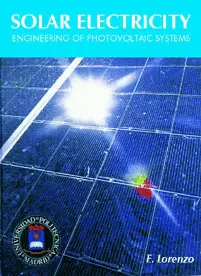
LORENZO, E.
U$ 55,13 56,50 €
U$ 55,13 56,50 €
1 Energy problems and solutions by photovoltaics.
1.1 Introduction.
1.2 Historical overview. Preindustrial epoch. The carbon era.
The oil era. Energy crises.
1.3 Some features of the present energy system.
1.4 Problems, risks and uncertainties. The exhaustion of
fossil fuels. The greenhouse effect. Acid rain.
Deforestation. Social tensions.
1.5 Solar photovoltaic energy as an alternative.
1.6 Current state of photovoltaic technology and market.
1.7 Future scenarios. Widening of the North-South divide.
Link between economics and ecology. Energy crises.
Evolution of photovoltaic technology. Absence of
structural limitations. Quantification of scenarios.
1.8 Photovoltaic solar energy in Spain.
2 The solar cell.
2.1 Introduction.
2.2 The solar cell. Structure. How it works.
2.3 Photogeneration of current. Absorption of light and
generation of carriers. Collection fo current. Quantum
efficiency.
2.4 Dark current.
2.5 Characteristic I-V curve under ilumination. Shortcircuit
current and open-circuit voltage. Maximum power
point. Fill factor and conversion efficiency.
2.6 Equivalent circuit of a solar cell. Circuit for the ideal
device. Series and parallel resistances.
2.7 Additions to the simple model. Influence of
temperatures. Influence of illumination intensity.
3 The photovoltaic generator.
3.1 Introduction.
3.2 The I-V characteristic of a photovoltaic generator.
Uneful expressions. Obtaining the characteristic
parameters.
3.3 The photovoltaic module. Standard conditions and
nominal operating temperature. Behaviour under
62 63
arbitrary conditions. Example. Efficiency and operating
conditions.
3.4 Interconnection of photovoltaic modules. Mismatch
losses. The hot-point problem.
3.5 Miscellaneous practicalities. Support structures. Cables.
Protective measures. Shadowing among modules.
4 The photovoltaic system.
4.1 Introduction.
4.2 Lead-acid batteries. Principle of operation. What they
are made out of. Some definitions. Charging.
Discharging. Cycling. Temperature effects. Alloy grids.
Batteries for use with photovoltaics. Mathematical model.
Practical precautions.
4.3 Power conditioning. Blocking diodes. Charge
regulators. DC-DC converters. DC-AC converters.
5 Solar radiation.
5.1 Introduction.
5.2 The nature of solar radiation.
5.3 Movement between sun and earth. Position of the sun
relative to the earth´s surface.
5.4 Estimation of the components of solar radiation.
Extraterrestrial radiation. Estimation of total irradiation,
based on other meteorological variables. Estimation of
the direct and difusse components of horizontal
radiation, based on the total irradiation. Estimation of
hourly radiation, based on daily values.
5.5 Radiation on surfaces of any inclination. Direct
irradiance. Diffuse irradiance. Albedo irradiance. Daily
irradiation of inclined surfaces.
5.6 Generation of sequences of daily radiation.
5.7 Diurnal variations of ambient temperature.
5.8 The typical meteorological year.
5.9 Effect of the angle of incidence.
5.10 Shadows and trajectory maps.
5.11 Irradiation of surfaces of special interest. Irradiation
of fixed, inclined, south-facing surfaces. Irradiation on
suntracking surfaces. Irradiation for concentrators.
6 Sizing of autonomous photovoltaic systems.
6.1 Introduction.
6.2 Reliability map.
6.3 Review of existing methods. Intuitive methods.
Numerical methods. Analytical methods.
6.4 The method proposed.
6.5 Sizing for high reliability.
6.6 Efficiency of photovoltaic generators.
6.7 Example of sizing.
7 Applications of photovoltaics.
7.1 Introduction.
7.2 Telecommunications.
7.3 Electricity for rural areas. Domestic supply, Europe.
Domestic supply, poor countries. Sheepfarming.
7.4 Water pumping.
7.5 Grid connection. Power stations which feed the grid.
Systems which exchange energy with the grid.
7.6 Other applications.
7.7 Economic considerations. Grid-isolated systems.
Grid-connected systems.
8 Manufacturing technology for silicon solar cells.
8.1 Introduction.
8.2 Obtaining and purifying silicon.
8.3 Crystal growth and preparation of wafers. Growth of
crystal ingots. Cutting the ingots into wafers. Direct
growth of layers and films of crystalline silicon.
8.4 A typical manufacturing process. Surface preparation.
Formation of the pn junction. Formation of p+ region at the
back surface. Formation of contacts. Antireflective coating.
8.5 Advanced manufacturing technology. Buried contacts.
MIS cells. Bifacial cells.
8.6 Construction of modules.
8.7 Energy put into making photovoltaic modules.
9 Cells and systems using concentration.
9.1 Objectives of using concentration in photovoltaics.
9.2 Limits to optical concentration. Angular aperture and
concentration. Static concentrators. Tracking concentrators.
Optical losses.
9.3 Current position. Two-stage concentration.
9.4 Methods of decoupling optical and electrical covering.
9.5 Concentration and trapping of light.
10 Complementary bibliography.